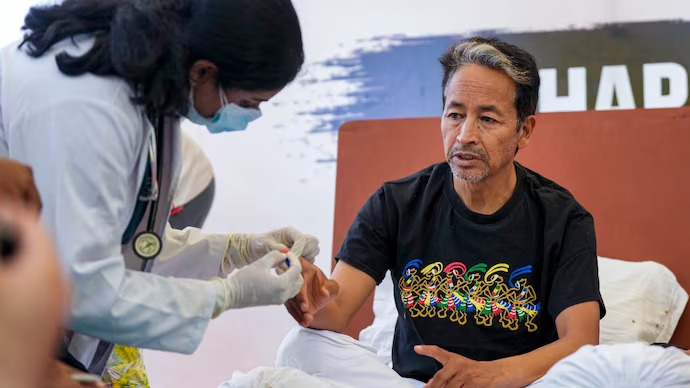
Delhi High Court orders immediate shift of Sonam Wangchuk to Medanta Hospital
12:49 PM, Tuesday,21 July 2026
Court says transfer necessary to protect Mr. Wangchuk’s fundamental rights
he Delhi High Court on Tuesday (July 21, 2026) directed that activist Sonam Wangchuk, who has been on a 24-day hunger strike in solidarity with the Cockroach Janata Party (CJP) student protest, be immediately shifted from Safdarjung Hospital to Medanta Hospital in Gurugram, holding that the transfer was necessary to ensure his safety and protect his fundamental rights under Articles 19 and 21 of the Constitution.
Allowing an appeal filed by Mr. Wangchuk’s wife, Ms. Gitanjali J. Angmo, a Bench of Chief Justice D.K. Upadhyaya and Justice Tejas Karia noted that its interaction with doctors from AIIMS and Safdarjung Hospital revealed medical concerns requiring constant supervision.
“On interaction with the doctors of AIIMS and Safdarjung Hospital, what we found is that certain concerns primarily relate to the low TLC and the potassium level in the blood sample of the husband of the appellant,” the Bench observed.
The Court recorded that there was a consensus among the doctors that Mr. Wangchuk required “constant and continuous monitoring” by medical experts. The Bench also took note of the appellant’s submission that Mr. Wangchuk could receive medical care at Medanta Hospital in Gurugram.
Senior Advocate Kapil Sibal, appearing for Ms. Angmo, argued that the case involved a violation of Mr. Wangchuk’s fundamental rights guaranteed under Articles 19 and 21 of the Constitution.
Taking into account the submissions of the parties and the medical opinion on record, the Court held, “Having regard to the submissions made by the parties, the opinion expressed by the doctors, and the concerns raised by them, we are of the opinion that the husband of the appellant ought to be shifted to a hospital of choice.”
Solicitor General Tushar Mehta, appearing for the Centre, informed the Court that the government had no objection to Mr. Wangchuk’s hospitalisation at Medanta.
The Court also directed the Director of Medanta Hospital to immediately constitute a team of doctors with the requisite expertise to constantly monitor Wangchuk’s health and administer the medical treatment that he would be required to follow.
Addressing concerns over access to Mr. Wangchuk during his treatment, the Court further directed that, subject to medical protocol, Ms. Angmo would be permitted to visit her husband at Medanta Hospital whenever she desired.
“The Court’s concern is only to do with his safety and his fundamental rights. Nothing to do with what is going around,” the court said.
During the hearing, the court interacted with doctors from AIIMS, who are part of the team monitoring Mr. Wangchuk at Safdarjung Hospital, as well as with his treating physician.
Mr. Sibal also drew the Court’s attention to a letter by Mr. Wangchuk alleging restrictions during his stay at Safdarjung Hospital including restriction on using his mobile phone, access to visitors, and surveillance.